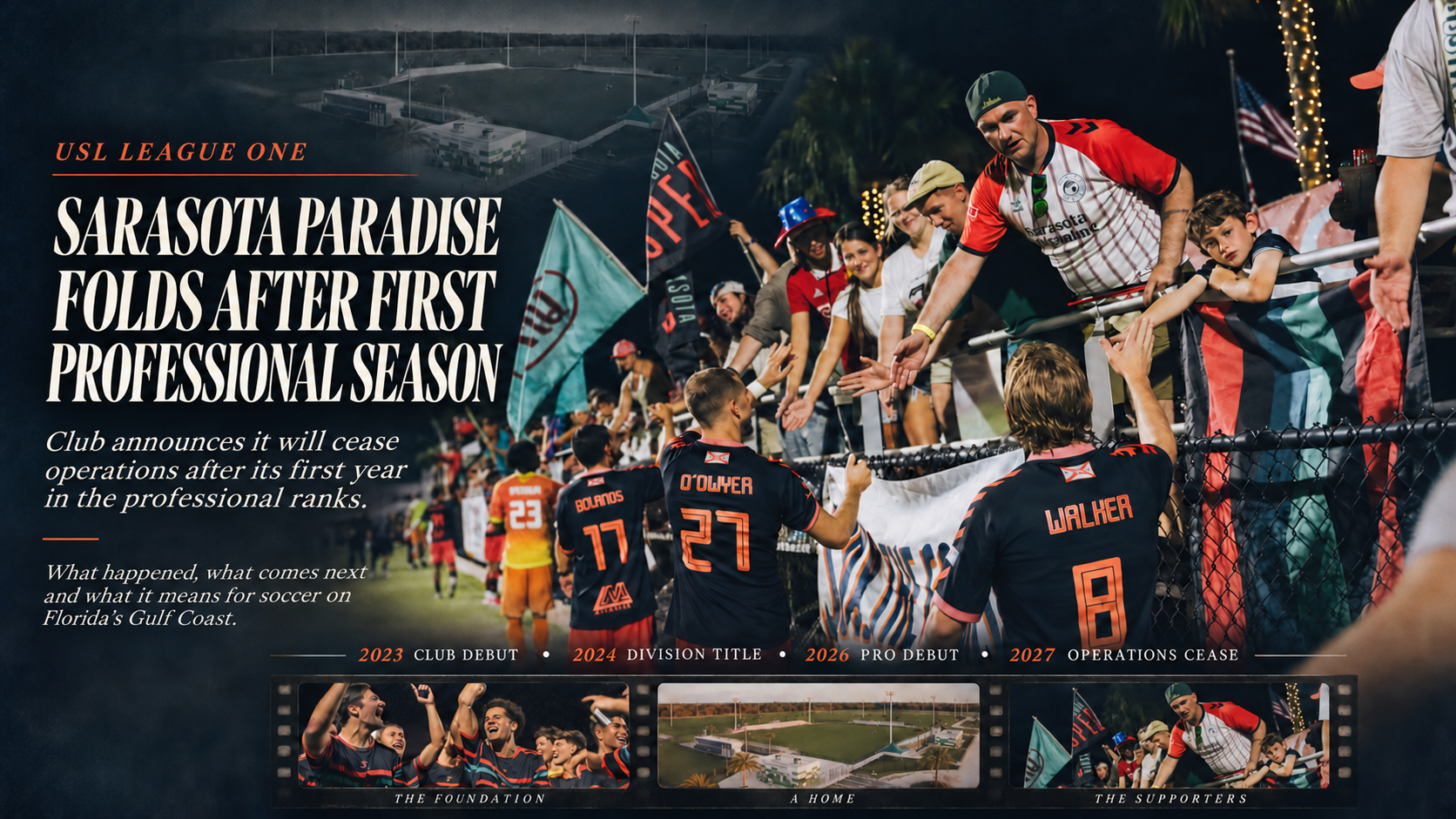
Sarasota, Florida —Sarasota Paradise’s first professional season will also be its last, at least as the club currently exists. On Nov. 13, the Lakewood Ranch-based organization announced that it would discontinue operations and would not participate in the 2027 USL League One season. The announcement arrived less than three weeks after the club’s final regular-season match, a 2-2 draw with Westchester SC at Premier Sports Campus on Oct. 24. Sarasota closed its inaugural League One campaign at 11-14-7, finishing 11th in the 17-team table and six points outside the playoff field. It was not a season without progress, nor was it a season that made the closure appear inevitable from the outside. The Paradise had been founded in November 2022, spent three seasons in USL League Two, and then made the difficult leap into the professional third division for 2026. Its public statement did not specify a cause for the shutdown. It did say that applicable 2027 season-ticket and sponsorship payments would be addressed directly with affected supporters and partners. That language is the first practical consequence of a decision that instantly changes the status of players, employees, vendors, fans and a community that had been asked to view the club as a long-term project. The headline, then, is not simply that Sarasota missed the postseason; it is that a club built to become the Sarasota-Manatee area’s professional soccer home will not take the field next year under its current ownership and operating structure.
The most responsible reading of the collapse is that it cannot yet be reduced to one publicly proven cause. The club has not laid out a detailed explanation, and no report has established a single decisive financial or operational trigger. Still, the timing and the available record point to a fragile organization facing the full pressure of a professional launch. Sarasota’s on-field season was uneven, but it finished with signs of life rather than competitive free fall: after sitting at 5-12-3 in mid-August, the team put together a seven-match points streak and went 4-0-3 from Aug. 19 through Sept. 26. Coach Mika Elovaara said after the season that the club had played at a top-three points-per-game pace in the second half, an indication that performance alone does not explain why the organization stopped. The off-field picture was more unsettled. Founder Marcus Walfridson had stepped down as CEO in July, leaving Marco Assis as principal owner while the club searched for new day-to-day leadership. In late October, the club was still publicly discussing 2027 and Manatee County was interested in a longer agreement at Premier Sports Campus, even though a new lease had not been finalized. That is the profile of a startup that had found some traction but had not yet created enough institutional margin for leadership change, facility costs, sales obligations, player commitments and the daily cost of professional operations. It would be careless to declare which of those pressures was decisive without documents or a detailed club explanation. It is fair, however, to say that moving from a summer developmental team to a year-round professional enterprise demands deeper capitalization, stronger back-office capacity and a longer runway than an encouraging first season can guarantee.
The possibility of a rescue makes the next phase more complicated, not less. Reporting indicates that a potential investor has contacted the USL about rescuing the club, though a return to League One next season remains a long shot. A buyer would not be purchasing a clean slate. The first task would be to satisfy the league that the ownership group has the capital, governance and operating plan to field a credible 2027 club on a compressed timeline. The second would be to establish control of the club’s commercial obligations, including the commitments made to season-ticket holders and sponsors, and to determine what remains of its venue, staff and player infrastructure. The third would be to convince the market that this is a real reset rather than a brief reprieve. That requires clarity about who is in charge, what has changed and how the organization will avoid asking supporters to carry the emotional cost of another sudden interruption. The league’s calendar does not pause while those questions are answered: player recruitment, technical staffing, ticket sales, sponsorship activation, travel planning and facility preparation all need to move at once. The fact that an investor has made contact is meaningful because it shows the market and the club’s assets still hold some perceived value. It is not, by itself, evidence that a deal is close or that USL League One soccer will be back in Sarasota in 2027. Until an ownership agreement and league approval are announced, the only confirmed reality is the club’s own statement that operations are ending.
For Sarasota soccer, the loss is bigger than the removal of a name from a league schedule. The Paradise was built as both a professional team and a pathway, and the club said in August that nine rookies had made official professional debuts during its inaugural League One season. It also operated a youth academy and U20 program, which made the professional side a visible endpoint for local players and families rather than simply another entertainment option. A shutdown threatens that connective tissue first: the young player who saw a local route to a pro debut, the volunteer who helped create matchday culture, the business that bought into a sponsorship and the supporter who believed the club had finally given the area a stable soccer identity. None of that means the Sarasota-Manatee market has failed a test it was never fully allowed to finish. The club’s late-season run, its supporter culture and the attention now being paid to a possible rescue all suggest that there is real interest in the sport and in a local professional identity. The sharper question is whether interest can be converted into a durable operating model with ownership capable of absorbing early losses and building trust over several years. That distinction matters because markets do not disappear simply because a first ownership group cannot continue. Sarasota remains a growing region with youth-soccer infrastructure, a usable venue and a demonstrated appetite for a local club. What it lacks today is certainty that the professional layer of that ecosystem will still exist when the 2027 season begins.
The Paradise closure also lands during a sobering moment for USL League One. Sarasota is the fourth club to fold in 2026 after South Georgia Tormenta shut down before the season, while Westchester SC and Corpus Christi also dropped out after the campaign. For a league trying to expand its national footprint, every abrupt exit raises the same hard questions about ownership standards, market readiness and how quickly a new club can be expected to become self-sustaining. Sarasota should not be used as a blunt argument against smaller-market professional soccer; the sport’s strongest American stories are often built in communities that larger leagues once ignored. But it should be treated as a reminder that a crest, a stadium agreement and a first-year roster are not the same thing as a durable club. The enduring organizations are the ones that enter their lean years with enough capital, leadership continuity and local trust to survive them. A new owner could still give Sarasota a second chance, whether through an immediate League One rescue or a more deliberate re-entry at another level. If that happens, the lesson cannot be to repeat the first launch more efficiently; it has to be to build more patiently. Until then, the most professional way to describe the Paradise is also the simplest: a promising club reached the professional stage, completed one season and then folded before its second could begin. The work now is to determine whether that ending becomes Sarasota soccer’s warning or the foundation for a more stable return.

Jonathan Brown started SPCSN in 2018 as a sports highlight company and started with doing videos for friends and teammates at his Alma Mater Johnson University Florida. As he progressed as an athlete and sports broadcaster in college, he began to see a need for many small colleges and semi-professional teams. He became fascinated with local team markets and wanted to show the whole world what these teams showed. In 2019, Brown transitioned his business into a sports network focused on non-NCAA DI schools, semi-professional sports, and select minor/development leagues. Brown currently serves as the CEO and chairman of the board.